
- All
- Product Name
- Product Keyword
- Product Model
- Product Summary
- Product Description
- Multi Field Search
Views: 0 Author: Site Editor Publish Time: 2026-03-19 Origin: Site


Ever wonder why crushers fail prematurely? Crusher Parts like mantles and jaw plates endure extreme wear and impact. In this article, you'll learn how Qirun designs and manufactures durable wear parts for consistent mining performance.
Crusher parts are the heart of any crushing operation. They can be categorized into wear parts and spare parts. Wear parts directly contact the rock or ore and gradually degrade under heavy abrasion and impact. These include jaw plates, mantles, concaves, blow bars, liners, and hammers, which are crucial for maintaining consistent crushing performance. Spare parts, on the other hand, support the machine’s operation, such as bearings, shafts, toggle plates, and hydraulic components, and help prevent downtime by allowing quick replacements when needed. In short, without reliable crusher parts, even the most robust crushers struggle to operate efficiently. They ensure smooth material flow, stable output, and reduced energy .
Cone crushers rely on a few critical components to handle secondary and tertiary crushing stages. The mantle, the moving crushing surface, works against the concave or stationary surface, effectively breaking material through compressive forces. Other essential parts include the main shaft, eccentric, head, adjustment ring, and hydraulic cylinders, which collectively control the crusher’s stroke, gap, and overload protection. Each part has a specific function: the eccentric moves the mantle, the adjustment ring sets output size, and hydraulic cylinders allow safety and precise tuning. Below is a simplified diagram of cone crusher components:
Component | Function |
Mantle | Moving crushing surface, breaks rock under compression |
Concave | Stationary liner, works with mantle to crush material |
Main Shaft | Supports mantle and transmits motion from eccentric |
Eccentric | Rotates mantle, generates crushing stroke |
Adjustment Ring | Controls gap between mantle and concave, sets output size |
Hydraulic Cylinder | Protects crusher from overload, assists adjustment |
Proper maintenance and selecting wear-resistant materials like high manganese steel or high-chrome alloys extend component life, ensuring consistent performance in tough mining and quarry operations.
Jaw crushers perform primary crushing, relying on fixed and movable jaw plates to compress large feed material. Side liners, cheek plates, and toggle plates protect the frame and allow movement under heavy loads. Jaw plates absorb both impact and abrasive forces, gradually wearing down over time. High manganese steel alloys (Mn13, Mn18, Mn22) are typically used due to their work-hardening properties, which increase durability with use. Operators often monitor wear rates to schedule replacements and prevent production interruptions. A visual of typical jaw crusher wear parts:
● Fixed Jaw Plate – stationary surface for material compression
● Movable Jaw Plate – reciprocating surface that crushes material
● Side Liners – protect side walls of the crushing chamber
● Toggle Plate – safety device, allows jaw to swing if uncrushable material enters
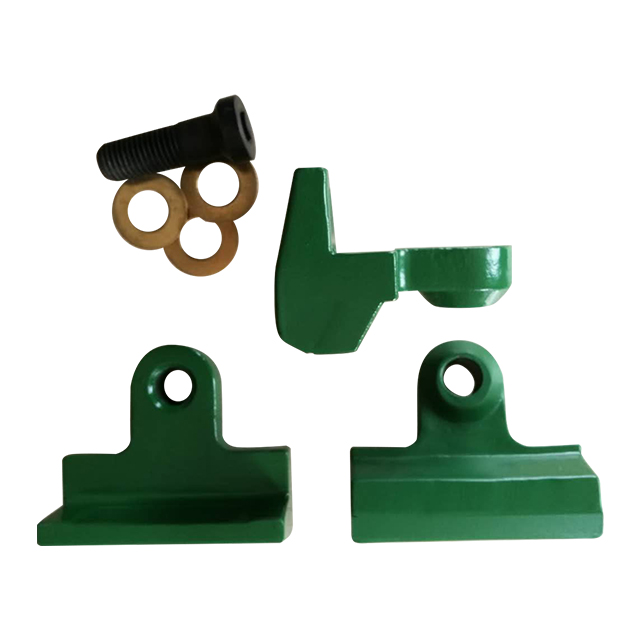
Impact and roller crushers handle high-speed, high-impact crushing and require specialized parts. Blow bars, impact plates, rollers, and hammers endure rapid material collisions and abrasions. Materials like high-chrome alloys or bimetallic designs with ceramic inserts are often used to maximize lifespan and performance. Proper installation and regular inspection are crucial to prevent uneven wear or mechanical failure. Operators often combine material choice, feeding control, and rotation speed adjustments to optimize crushing efficiency. Considerations include:
● Blow Bars – strike material, must resist high-speed impact
● Impact Plates – stationary surface absorbing collisions
● Rollers & Hammers – apply compressive or shear forces in roller crushers
● Material Choice – high-chrome or manganese alloys for longevity
Choosing the right material is critical for Crusher Parts to handle heavy loads and abrasive mining conditions. Key options include:
● Manganese Steel – Excellent toughness, work-hardening ability; ideal for jaw plates and cone liners in primary and secondary crushing. It becomes harder under repeated impact, extending part life.
● High Chrome Iron – Extremely hard and abrasion-resistant, perfect for blow bars and impact plates in high-speed crushers.
● Alloy Steels & Composite Materials – Balanced toughness and wear resistance for specialized applications, including high-abrasion or high-impact zones.
Why it matters: Proper material selection reduces wear, lowers downtime, and maintains consistent crushing efficiency. Qirun manufactures all materials under strict quality control, ensuring durability in demanding operations.
Material Type | Key Property | Typical Applications | Advantages |
Manganese Steel | Toughness, work-hardening | Jaw plates, Cone liners | Self-hardens under impact |
High Chrome Iron | Hardness, abrasion resistance | Blow bars, Impact plates | Long wear life |
Alloy Steel | Strength, balanced durability | Liners, Hammers | Customizable for crusher needs |
Composite Materials | Layered wear-resistant design | Specialized high-abrasion parts | Extended service life |
Material choice depends on operational factors. Consider:
● Crusher type and crushing stage – Primary crushers need high impact toughness; secondary or tertiary crushers focus on abrasion resistance.
● Ore hardness and abrasiveness – Harder or more abrasive ores wear parts faster, requiring tougher alloys.
● Operating conditions – Feed size, speed, moisture, and tramp metal risk affect wear and part performance.
Using proper materials ensures stable throughput, reduces energy consumption, and prolongs wear part life. Qirun also provides guidance on material selection tailored to your crusher type and application.
High-quality Crusher Parts depend on precise manufacturing steps:
● Casting Techniques – Sand mold or lost mold casting ensures dimensional accuracy and dense material structure.
● Heat Treatment – Hardens the parts for toughness and long service life under impact.
● Machining & Inspection – Chemical composition, hardness, and structural integrity are checked using hardness testers, impact testers, and ultrasonic flaw detectors.
Qirun integrates all these steps to deliver parts that meet demanding mining and aggregate applications.
Design adjustments can significantly boost crusher efficiency:
● Cone Angles – Steeper for finer crushing, broader for coarser output.
● Jaw and Tooth Profiles – Optimize material grip and throughput in jaw crushers.
● Ceramic Inserts & Bimetallic Overlays – Protect high-abrasion surfaces, reducing wear and extending life.
Maintaining Crusher Parts starts with routine checks to catch wear early. Operators should look for cracks, deformation, or thinning in jaw plates, mantles, concaves, and blow bars. It's also crucial to monitor alignment, fasteners, and operating parameters such as vibration, temperature, and rotational speed. Using a combination of visual inspection, hardness testing, and ultrasonic detection helps identify hidden flaws before they escalate into failures. A small table illustrates typical signs and corresponding actions:
Wear Sign | Likely Cause | Recommended Action |
Cracks | Overload or tramp metal impact | Immediate replacement or repair |
Thinning | Abrasive feed or prolonged use | Schedule part replacement |
Misalignment | Loose fasteners or incorrect setup | Adjust bolts and realign components |
Vibration increase | Imbalance or worn components | Inspect rotors, jaw, or cone liners |
Knowing when to replace parts is essential for efficiency. Worn mantles, concaves, jaw plates, or blow bars reduce crushing performance and produce inconsistent product sizes. Replacement timing depends on material hardness, crusher type, and feed conditions. For instance, jaw plates in high-abrasion operations may need replacement sooner, while impact blow bars last longer if feed is controlled. Qirun provides factory-direct replacement parts that match original specifications, helping maintain optimal crusher performance.
Proper installation ensures even wear and extended lifespan. All parts should be correctly fitted and aligned, preventing stress concentrations that lead to premature failure. Lubrication is vital for moving components such as the eccentric shaft or swing jaw; it reduces friction, controls heat, and prevents seizing. Operators should follow recommended grease schedules and check for leaks or contamination. Using quality crusher parts from reputable suppliers like Qirun guarantees correct dimensions, precision casting, and material reliability.
Operational practices significantly influence wear part longevity. Key strategies include:
● Consistent feed rate: Avoid overloading or uneven feed that stresses wear parts.
● Preventative maintenance schedule: Regularly replace wear items based on hours of operation, not just visible damage.
● Choose high-quality parts: Selecting manganese steel jaw plates, high-chrome blow bars, or bimetallic cone liners ensures longer service life.
Additional tips: rotate jaw plates, inspect hydraulic systems, and maintain clean crushing chambers. A concise checklist:
● Inspect for cracks and deformation weekly
● Maintain proper lubrication intervals
● Monitor feed and material hardness
● Replace wear parts before critical failure
Selecting a reliable Crusher Parts supplier is essential for consistent performance. Look for companies that provide precision casting, consistent material quality, and thorough testing. They should offer technical support, after-sales services, and documentation, including chemical composition and hardness reports. Traceability is key, so each part can be tracked back to its batch, ensuring quality and accountability. Qirun, for instance, implements raw material analysis, dimensional checks, and impact testing to guarantee each component meets rigorous mining standards. Key considerations include:
● Material consistency – ensures long wear life and reduces unexpected downtime.
● Technical support – assists in selecting parts for specific ore and crusher types.
● Quality documentation – certificates for chemical composition, hardness, and impact resistance.
Supplier Feature | Why It Matters | Example Benefit |
Material Consistency | Reduces early wear and machine failure | Longer operational life of jaw or cone plates |
Technical Support | Guides proper selection and maintenance | Optimal fit and efficiency |
Traceability & Testing | Ensures accountability and quality | Confidence in factory-direct parts |
Modern mining requires crusher parts tailored to ore type, crusher model, and operational conditions. Customization can involve adjusting material grades, part geometry, and wear-resistant overlays. For example, a cone crusher handling highly abrasive granite may benefit from Mn22Cr2 liners, while softer limestone may use Mn13 alloys. Factory-direct suppliers like Qirun allow direct adjustments, reducing lead times, minimizing costs, and ensuring precise fit. Customers can request:
● Customized wear part materials
Materials selected based on ore hardness, abrasiveness, and expected service life.
● Design modifications
Tailored changes to jaw plates, mantles, and blow bars to enhance crushing efficiency and uniform wear.
● Direct factory supply
Fast, reliable delivery from the manufacturer for reduced logistics costs and guaranteed specifications.
This approach ensures each Crusher Part delivers maximum efficiency, consistent product size, and extended service life. Qirun’s engineering expertise and advanced casting lines allow them to produce tailored components that meet exact specifications for both primary and secondary crushers.
Crusher cone and wear parts are essential for efficient mineral processing. Qirun provides high-quality crusher parts including jaw plates, mantles, concaves, and blow bars, designed with durable materials and precision casting to maximize performance, reduce downtime, and extend equipment life in demanding mining and quarry operations.
A: Crusher parts are essential components such as jaw plates, mantles, and concaves that break down ore and rock in mining and aggregate operations, ensuring efficient material processing and consistent output.
A: Selecting the correct crusher parts involves considering the crusher type, ore hardness, and operating conditions. Proper selection improves wear resistance, optimizes performance, and extends part lifespan.
A: Material choice directly affects durability and efficiency. Using manganese steel, high chrome iron, or specialized alloys enhances wear resistance, reduces maintenance frequency, and ensures reliable operation under heavy loads.
A: Crusher parts like mantles, concaves, jaw plates, and blow bars should be replaced when signs of wear, thinning, cracks, or misalignment appear to maintain product size consistency and operational efficiency.
A: Factory-direct suppliers like Qirun provide precision-cast, wear-resistant parts, customization for specific crusher models and ores, technical support, and quality assurance, ensuring reliable performance and minimizing downtime.


