
- All
- Product Name
- Product Keyword
- Product Model
- Product Summary
- Product Description
- Multi Field Search
Views: 0 Author: Site Editor Publish Time: 2026-02-04 Origin: Site
Choosing the wrong crusher can waste time. A Stone Crusher is key in mining and construction. You will learn how to select the right type. We discuss material, output, site, and costs.
Selecting the right stone crusher starts with understanding the specific equipment types and how they match the material characteristics and operational goals. Each crusher type is designed for certain hardness levels, particle size reduction, and operational contexts. Integrating the right crusher into your workflow can optimize throughput, reduce wear, and ensure consistent product quality. The following overview combines operational insights, typical use cases, and efficiency considerations.
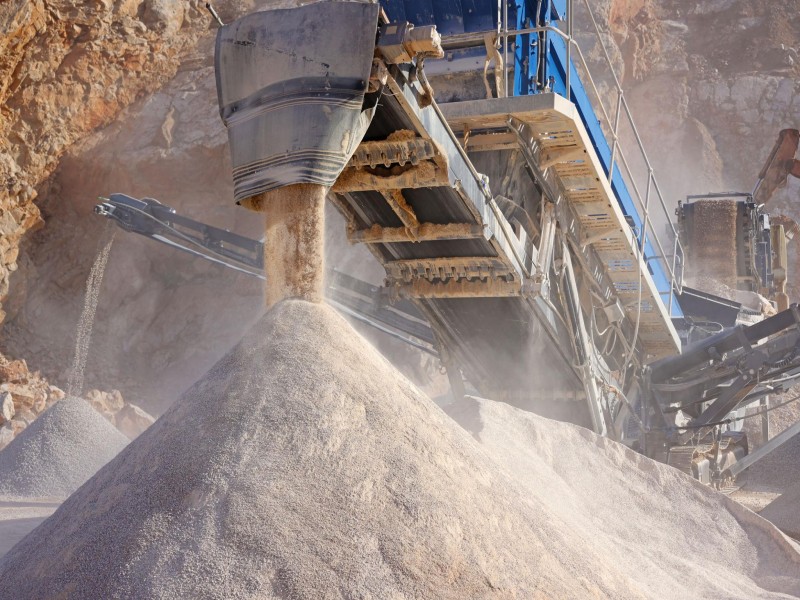
Jaw crushers are the cornerstone of primary crushing in most aggregate and mining operations. They operate by compressing material between a stationary and a moving jaw, efficiently reducing large, hard rocks such as granite, basalt, and iron ore into manageable sizes. Their large feed openings and robust design make them ideal for handling coarse material and high-throughput demands. The adjustable discharge allows operators to fine-tune the output size, accommodating different production requirements.
Key Features and Advantages:
● High crushing efficiency for very hard and abrasive materials.
● Simple mechanical structure with minimal maintenance requirements compared to other primary crushers.
● Can be deployed in stationary or mobile configurations, providing operational flexibility.
Feature | Description | Typical Application |
Feed Size | Up to 1m for large jaw crushers | Quarry primary crushing |
Throughput | 150–1500 tph | Mining and aggregate plants |
Maintenance | Low complexity, easy access | Long-term operations |
Cone crushers are mainly used for secondary and tertiary crushing. They employ compressive force between a rotating mantle and a fixed bowl to achieve a uniform, cubical product. Cone crushers are particularly effective on medium to hard rocks and offer excellent control over the final particle shape and size. They are often integrated into multi-stage crushing circuits to provide consistent quality and throughput.
Operational Insights: Cone crushers allow hydraulic adjustment of the closed side setting (CSS), which enables operators to modify the output size without stopping the plant. The robust design ensures durability under high pressures, and modern units often include automated monitoring systems for optimized performance and wear management.
Parameter | Secondary Cone | Tertiary Cone |
Feed Size | 150–300 mm | 40–150 mm |
Output Range | 20–100 mm | 5–40 mm |
Power Requirement | 50–200 kW | 30–120 kW |
Impact crushers rely on high-speed impact forces to fracture softer to medium-hard rocks such as limestone, concrete, and coal. They are designed to create a more cubical product shape, which is ideal for construction applications like road base or concrete aggregate. Horizontal shaft impactors (HSI) are suitable for through-feed operations, while vertical shaft impactors (VSI) excel in fine shaping and sand production.
Highlights and Benefits:
● Adjustable rotor speed and feed configurations for optimized particle size.
● Cost-efficient for secondary or tertiary crushing with moderate abrasiveness.
● Can be paired with mobile units for flexible deployment in temporary or remote sites.
Usage Consideration: Impact crushers are less suitable for very hard or highly abrasive rocks, as the high-speed impact may increase wear on hammers and liners. Proper material analysis is critical to match crusher type with feed characteristics to maintain efficiency and reduce downtime.
Hammer crushers, also known as hammer mills, operate by striking materials with high-speed rotating hammers within a containment chamber. They are particularly effective for brittle or low-to-medium hardness materials, such as coal, gypsum, chalk, and limestone. This type of crusher can handle various feed sizes and allows for secondary or tertiary reduction in smaller-scale operations.
Key Advantages:
● Simple and cost-effective design.
● High reduction ratio and adjustable end-product size through screen selection.
● Versatile for industrial processes beyond aggregate production, including cement and chemical material preparation.
Operational Tip: Although hammer crushers provide excellent pulverization, they require consistent monitoring of hammer wear and screen integrity. Replacement schedules must be adhered to in order to maintain consistent output quality and avoid unplanned downtime.
Mobile crushers provide flexibility for short-term projects, remote locations, or operations with frequent site changes. These units combine one or more crusher types (jaw, cone, or impact) with conveyors, feeders, and integrated control systems on a wheeled or tracked chassis. Quick setup, minimal foundation requirements, and compact footprints allow for immediate operation on-site, reducing material transport costs.
Advantages and Applications:
● Rapid deployment with minimal site preparation.
● Modular design enables combination of primary and secondary crushing in one mobile unit.
● Ideal for road construction, small quarries, and recycling applications where mobility and adaptability are critical.
Feature | Benefit | Typical Use |
Setup Time | Hours to a day | Temporary construction sites |
Flexibility | Can relocate easily | Multiple sites or uneven terrain |
Integration | Supports multiple crusher modules | Mobile aggregate production |
By carefully evaluating these crusher types against your project’s material characteristics, production goals, and operational constraints, you can design a crushing system that maximizes efficiency, reduces maintenance, and produces the desired output consistently. Integrating supporting equipment, selecting the proper crusher type, and considering mobile versus stationary deployment are all key to long-term operational success.
Selecting the right stone crusher requires a careful balance of technical, operational, and economic considerations. Understanding these key factors ensures that the crusher performs efficiently while minimizing maintenance, downtime, and overall costs. Decisions should be guided by the characteristics of the material, production requirements, site conditions, and financial constraints, rather than solely by price or brand.
The physical properties of the material being processed are critical to crusher selection. Hardness and abrasiveness directly influence wear rates, while moisture content and friability affect throughput and clogging risks. For example, granite or basalt, being hard and highly abrasive, require compression-based crushers like jaw or cone crushers for effective reduction, whereas softer materials such as limestone or shale are more efficiently processed with impact or hammer crushers. Assessing the material’s silica content, particle size distribution, and moisture profile helps in selecting wear-resistant liners and optimizing crusher performance.
Material Suitability Table
Material Type | Hardness | Recommended Crusher | Notes |
Granite/Basalt | Very Hard | Jaw/ Cone | High wear parts requirement, suitable for primary and secondary crushing |
Limestone/ Shale | Medium to Soft | Impact/ Hammer | Produces cubical particles, lower wear rates |
Coal/ Gypsum | Low | Hammer/ Sizer | Sensitive to moisture, avoid clogging, suitable for tertiary crushing |
Production goals dictate the capacity, configuration, and number of crushing stages needed. Throughput, typically measured in tons per hour, must align with the crusher’s rated capacity to avoid bottlenecks or overloading. The desired final product size and shape influence whether a single-stage crusher suffices or if a multi-stage setup is necessary. For instance, reducing a 600 mm boulder to 15 mm aggregate usually requires primary, secondary, and tertiary crushing stages, each optimized for gradual reduction and consistent particle sizing. Choosing a crusher that meets both output and quality requirements ensures operational efficiency and high-quality end products.
Key Considerations for Production Requirements
● Ensure crusher size matches intended throughput.
● Define final particle size and shape before selecting crusher type.
● Plan multi-stage crushing to avoid excessive fines or oversized material.
● Evaluate if the crusher can handle variations in feed size and material hardness without loss of efficiency.
Operational factors include site constraints, accessibility, and power supply. Limited space, height restrictions, or uneven terrain may necessitate mobile crushers, which offer flexibility and rapid deployment. Stationary crushers are better suited for permanent, high-volume installations with stable logistics. Additionally, compatibility with available power sources—electric, diesel, or hybrid—impacts installation costs and operational continuity. Operators should also account for ease of maintenance, accessibility of wear parts, and the availability of spare components to minimize downtime and sustain productivity over long-term operation.
Financial considerations extend beyond the initial purchase price. Total Cost of Ownership (TCO) includes ongoing expenses for energy, maintenance, replacement wear parts, and potential downtime. Investing in high-quality, durable components from reputable manufacturers often reduces long-term operational costs. Evaluating ROI requires balancing upfront capital against expected throughput, operational efficiency, and expected maintenance cycles. High initial costs may be justified if the crusher provides superior reliability, lower maintenance requirements, and energy-efficient operation, ultimately reducing the cost per ton of material processed.
Economic Comparison Table
Cost Factor | Impact on Operation | Optimization Strategy |
Initial Investment | Determines upfront capital allocation | Evaluate long-term benefits, not just price |
Wear Parts | Frequent replacement increases downtime | Select high-quality materials, match to rock type |
Energy Consumption | Significant operating expense | Use efficient motors, operate at optimal load |
Maintenance & Downtime | Reduces production time and revenue | Schedule preventive maintenance, maintain spare parts inventory |
By carefully analyzing material properties, production goals, site conditions, and cost factors, operators can make informed decisions that maximize efficiency, reduce wear and downtime, and ensure consistent product quality over the crusher’s service life.
Effective stone crushing often requires multiple stages to gradually reduce raw material to the desired particle size while ensuring product uniformity. Each stage—primary, secondary, and tertiary—serves a specific purpose within the overall workflow, and the choice of crusher type and configuration must reflect both the material properties and the production targets. Properly integrating these stages within a cohesive system maximizes efficiency, reduces wear, and maintains consistent throughput.
Primary crushing handles large, coarse feed directly from the quarry or mining face. Crushers such as large jaw crushers or gyratory units are typically employed, focusing on high throughput and initial size reduction. Secondary crushing further reduces material to an intermediate size, shaping particles and preparing them for finer processing. Cone crushers or impact crushers often dominate this stage due to their ability to produce uniform output with controlled particle shape. Tertiary crushing is used when the final product requires precise sizing or specific particle shape, as in manufactured sand or concrete aggregates. VSI (Vertical Shaft Impact) crushers or short-head cone crushers are often selected for this stage to ensure cubical, well-graded material.
Stage Comparison Table
Stage | Typical Crushers | Purpose | Key Considerations |
Primary | Jaw, Gyratory | Reduce large feed to manageable size | High throughput, handle hard rocks, minimal fines |
Secondary | Cone, Impact | Intermediate reduction and shaping | Consistent particle size, control wear, adjust output |
Tertiary | VSI, Short Head Cone | Final sizing, cubical particle production | Precise output, minimal fines, energy efficiency |
Optimizing each stage involves balancing feed size, crusher capacity, and reduction ratio to prevent bottlenecks. Multi-stage systems are designed to gradually reduce material, preventing overloading any single unit and minimizing maintenance interruptions.
A crushing plant is more than just the crushers. Vibrating feeders regulate the flow of material into the primary crusher, preventing surges or gaps that can reduce efficiency. Screens separate crushed material by size, ensuring only suitable particles move to the next stage. Conveyors connect different stages, maintaining steady throughput while minimizing material handling delays. Separators or magnetic units can remove unwanted fines or contaminants before final storage. Effective integration ensures that the system operates as a balanced workflow rather than discrete machines.
Supporting Equipment Flow Diagram (Simplified)
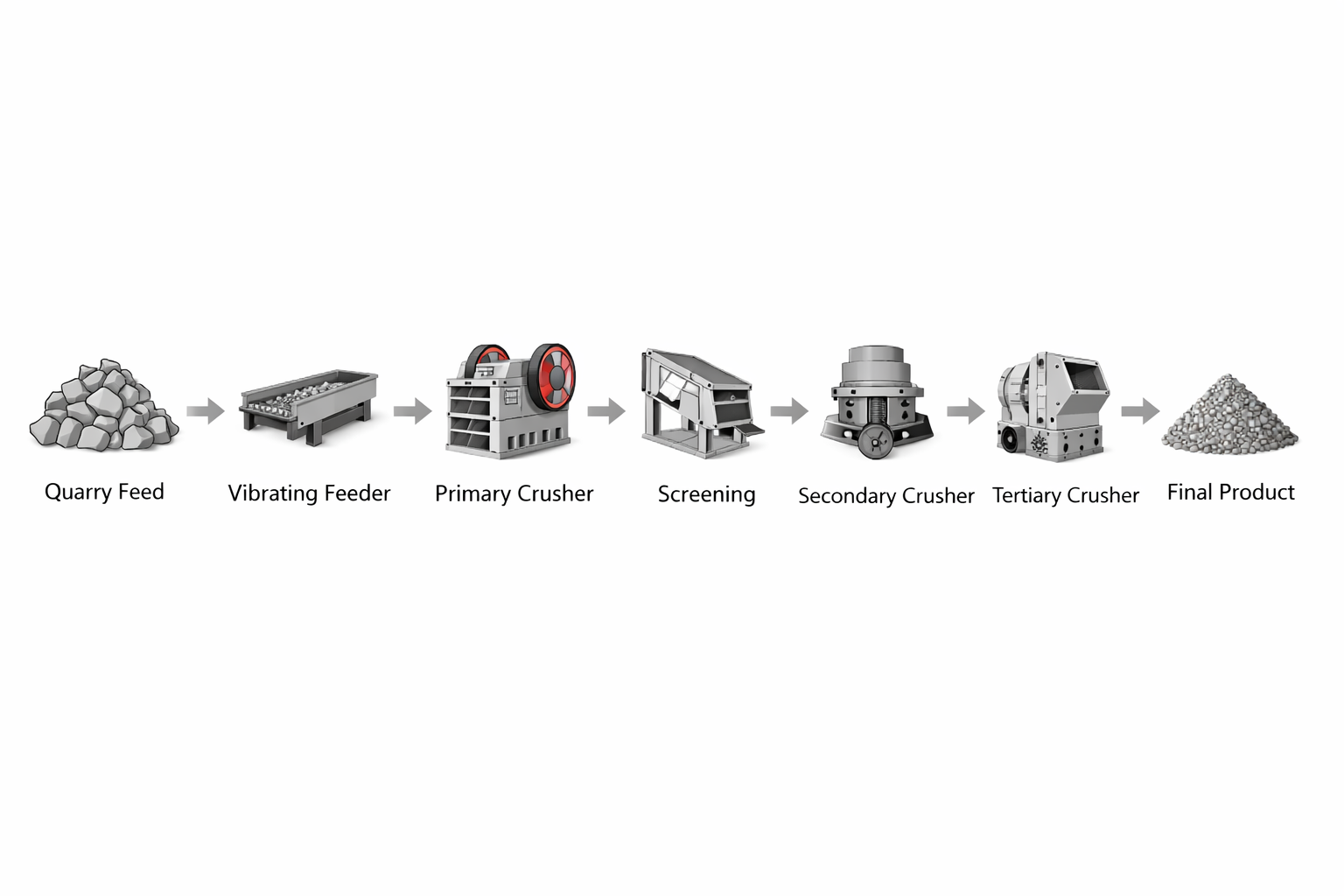
Balanced integration reduces downtime, improves material uniformity, and allows for predictive maintenance scheduling across the system.
Choosing between mobile and stationary stone crushers depends on project duration, location, and operational flexibility. Mobile crushers provide the ability to relocate quickly, ideal for temporary sites or multiple job locations. Stationary crushers are better for long-term, high-volume operations, delivering higher throughput with stable, low-maintenance performance.
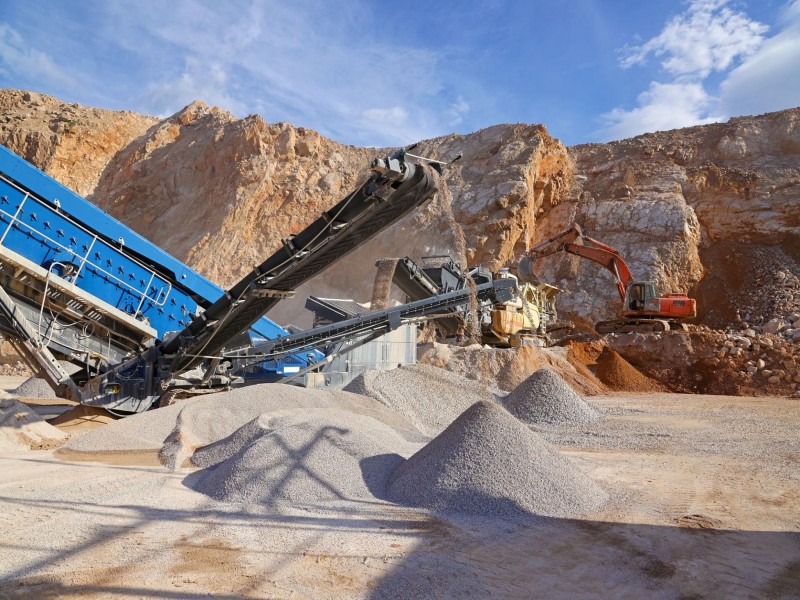
Mobile crushers can be moved on tracked or wheeled platforms, allowing them to operate near the feed source, minimizing haulage and improving overall efficiency. They are suited for road construction or short-term quarrying where site conditions change frequently. Stationary plants require civil works and foundations but offer greater stability, higher capacity, and less frequent maintenance interventions, making them ideal for permanent quarries.
Operating costs vary significantly between mobile and stationary units. Mobile crushers have higher initial purchase costs and may incur increased maintenance due to transportation and modular components. Stationary crushers have lower routine maintenance and repair costs due to simpler installation and accessibility. Evaluating cost per ton of production over the equipment lifespan provides a more accurate financial picture than purchase price alone.
Throughput performance is influenced by both crusher capacity and plant configuration. Mobile units may be slightly limited in maximum capacity but provide the operational advantage of positioning directly at material sources. Stationary plants can achieve higher continuous output, essential for large-scale operations where consistent production volumes are critical. Matching the crusher type and plant design to operational goals ensures maximum utilization and efficiency.
Proper maintenance is essential for extending the life of stone crushers and ensuring uninterrupted production. Regular inspections should include checking wear parts, lubrication systems, and structural integrity. Preventive maintenance minimizes unexpected downtime and maximizes equipment availability.
● Lubrication of moving parts according to manufacturer specifications to reduce friction and wear.
● Routine inspection of jaws, mantles, liners, and hammers to anticipate replacement needs.
● Cleaning and adjustment of screens, conveyors, and feeders to maintain smooth material flow.
Well-trained operators can significantly enhance operational safety and efficiency. Training should cover start-up and shutdown procedures, proper feeding techniques, monitoring of throughput and product quality, and early recognition of abnormal vibrations or wear patterns. Consistent adherence to best practices prevents premature wear, reduces downtime, and ensures optimal performance throughout the equipment lifecycle.
By combining multi-stage crushing strategies, supporting equipment integration, appropriate mobile or stationary configurations, and rigorous maintenance, operators can achieve high efficiency, consistent product quality, and long-term cost savings.
Selecting the right Stone Crusher ensures high efficiency. Understanding material, output, and site factors is crucial. Shuangfeng Qirun Machinery Parts Imp&Exp Co., Ltd. provides durable, reliable crushers. Their products improve productivity, reduce downtime, and maintain consistent quality.
A: Consider material hardness, feed size, desired output, throughput, and site conditions to select the right stone crusher.
A: Jaw crushers and cone crushers are optimal for hard, abrasive rocks due to their compression-based operation.
A: Match the crusher’s throughput with required tons per hour to avoid bottlenecks and maintain efficiency.
A: Mobile stone crushers offer flexibility for multiple sites but may have lower maximum throughput than fixed installations.


