
- All
- Product Name
- Product Keyword
- Product Model
- Product Summary
- Product Description
- Multi Field Search
Ever wondered how massive rocks become usable materials?
A Jaw Crusher is often the first machine to make that happen.
In this article, you will learn what a Jaw Crusher is, how it works, and where it is commonly used.
A Jaw Crusher is a mechanical crushing device designed to reduce large pieces of rock, ore, or construction material into smaller, more manageable sizes through compressive force. It operates using two rigid surfaces—commonly referred to as jaws—where one jaw remains fixed while the other moves back and forth in a controlled motion. Material fed into the crushing chamber is gradually compressed, fractured, and broken along its natural planes until it becomes small enough to exit through the discharge opening at the bottom. This simple but robust working concept makes the Jaw Crusher one of the most fundamental machines in size reduction systems.
From an engineering perspective, the Jaw Crusher plays a foundational role in material processing circuits. It is most often positioned at the front of a crushing line, where it handles the largest feed sizes and prepares material for downstream processing. Because it relies primarily on compression rather than impact, it is especially effective for hard, brittle materials that require controlled force rather than high-speed collision. Its straightforward mechanical layout also contributes to predictable performance and long service life under heavy-duty operating conditions.
Key characteristics that define a Jaw Crusher include:
● Compression-based crushing between a fixed and a moving jaw
● A V-shaped crushing chamber that guides material downward
● Mechanical simplicity compared with many other crushing machines
Aspect | Description |
Crushing method | Compression and squeezing |
Typical position | Primary crushing stage |
Feed size capability | Large, coarse material |
Mechanical complexity | Relatively simple |
A Jaw Crusher is used primarily to perform coarse size reduction on hard or abrasive materials before they undergo further processing. Typical feed materials include natural stone, blasted rock, mined ore, and various construction or demolition materials with irregular shapes and large initial sizes. By breaking oversized feed into smaller fragments through compressive force, the Jaw Crusher improves material flow and prepares the feed for secondary crushing or screening. The resulting output is not designed to be highly uniform in shape, but instead sized to meet the requirements of the next processing stage.
In practical applications, Jaw Crushers are widely used in mining, quarrying, aggregate production, and construction material recycling. They are especially valuable in environments where material hardness, variability, or the presence of impurities would reduce the efficiency of finer crushing equipment. Because a Jaw Crusher can accept a wide range of feed sizes and tolerate inconsistent material conditions, it is commonly selected as the first point of mechanical size reduction in a processing operation, helping stabilize downstream performance and overall system efficiency.
Common materials processed by Jaw Crushers include:
● Hard rock such as granite, basalt, and quartz
● Metal-bearing ores prior to beneficiation
● Limestone and other aggregate sources
● Concrete and mixed construction debris
Application area | Purpose of using a Jaw Crusher |
Mining | Initial reduction of run-of-mine ore |
Quarrying | Primary crushing of stone and aggregates |
Construction | Processing concrete and masonry waste |
Recycling | Handling mixed, irregular feed material |
A Jaw Crusher works by applying repeated compressive force to material trapped between two opposing jaw plates. One jaw is fixed in position, forming a stable crushing surface, while the other jaw is mounted on an eccentric shaft that drives a back-and-forth motion. As the moving jaw approaches the fixed jaw, material entering the V-shaped crushing chamber is squeezed, fractured, and split along natural weaknesses. When the moving jaw retreats, the crushed material shifts downward under gravity, making room for new feed at the top.
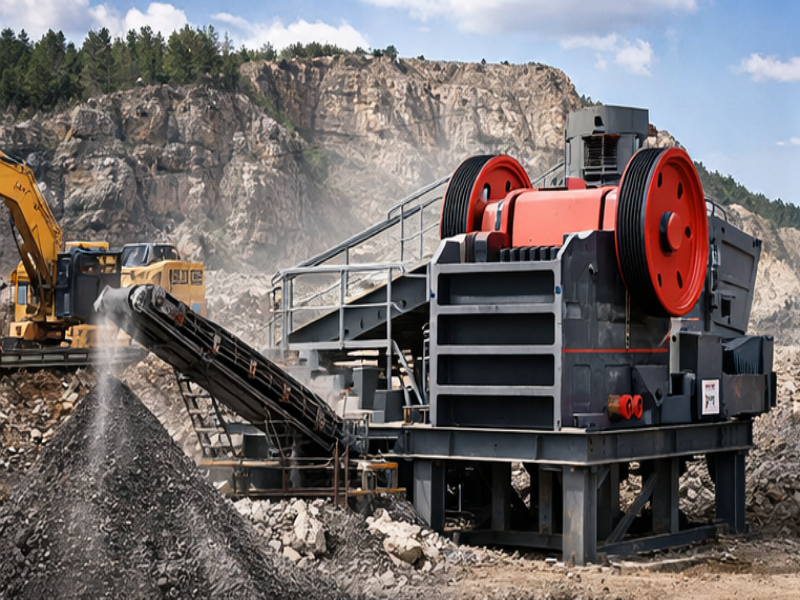
This cyclical motion creates a continuous crushing process rather than a single-impact event. Because the force is applied gradually and directly through compression, the Jaw Crusher is particularly effective for hard and abrasive materials that resist impact-based crushing. The geometry of the chamber ensures that material experiences multiple compression cycles as it travels downward, leading to progressive size reduction rather than sudden breakage.
Core mechanical actions involved in the crushing cycle include:
● Compression between fixed and moving jaws during the closing stroke
● Release and downward movement of material during the opening stroke
● Repeated engagement until particles are small enough to exit
Crushing stage | What happens to the material |
Jaw closing | Material is compressed and fractured |
Jaw opening | Broken material moves downward |
Repeated cycles | Progressive size reduction occurs |
The final particle size produced by a Jaw Crusher is primarily controlled by the discharge gap, often called the crusher setting. This gap represents the smallest distance between the fixed and moving jaws at the lowest point of their cycle. Only material that has been crushed to a size smaller than this opening can leave the chamber, while oversized particles are retained and subjected to additional compression cycles. As a result, adjusting the discharge gap directly changes how coarse or fine the final product will be, making it a key parameter in daily operation.
In practical operation, a narrower discharge gap produces finer output but usually comes with trade-offs such as reduced throughput, higher power consumption, and increased wear on jaw plates. A wider gap, by contrast, allows material to pass through more quickly, improving capacity but yielding coarser product. Operators must balance these effects based on production targets and material characteristics. While factors such as jaw plate design, feed size consistency, and material hardness all influence crushing behavior, the discharge gap remains the primary and most direct control over final particle size.
Factors influencing output size include:
● Discharge gap (closed side setting)
● Jaw plate shape and wear condition
● Consistency and size of incoming feed
Setting condition | Typical effect on output |
Narrow gap | Finer particle size, lower throughput |
Medium gap | Balanced size reduction and capacity |
Wide gap | Coarser output, higher throughput |
The structure of a Jaw Crusher is built around a small number of heavy-duty components that work together to generate controlled crushing force. At its core are two jaws: a fixed jaw that provides a stable crushing surface and a moving jaw that delivers the compressive motion. Both jaws are fitted with replaceable jaw plates, typically made from wear-resistant materials, which directly contact the feed material and absorb most of the mechanical stress during operation.
Power transmission and motion control are handled by the eccentric shaft and toggle mechanism. The eccentric shaft converts rotational motion from the drive system into the oscillating movement of the moving jaw, while the toggle plate transfers force and helps protect the crusher from overload. All of these components are supported by a rigid frame, which maintains alignment and structural stability under continuous high loads. This layout prioritizes strength and simplicity, allowing the crusher to operate reliably in demanding environments.
The main structural elements can be grouped by function:
● Crushing elements that contact material and perform size reduction
● Motion and force transfer components that drive jaw movement
● Structural components that support and stabilize the entire assembly
Component | Primary role in the structure |
Fixed jaw | Provides a stable crushing surface |
Moving jaw | Applies compressive force to material |
Jaw plates | Protect jaws and transmit crushing force |
Eccentric shaft | Drives oscillating jaw motion |
Toggle plate | Transfers force and absorbs overload |
Frame | Supports and aligns all components |
The effectiveness of a Jaw Crusher comes from how its structural components work together rather than from any single part. When the eccentric shaft rotates, it drives the moving jaw through a defined path, creating repeated compression cycles against the fixed jaw. The jaw plates ensure consistent contact with the material, while their shape helps guide particles downward through the crushing chamber. This coordinated motion allows material to experience multiple controlled compressions before exiting the crusher.
Structural rigidity plays a critical role in maintaining stable crushing force. The frame resists deformation, keeping the jaw alignment consistent even under fluctuating loads, while the toggle mechanism helps distribute forces and reduce stress concentrations. Together, these elements allow the crusher to apply high pressure efficiently and predictably, which is essential for processing hard or abrasive materials. By understanding this structural interaction, readers can better appreciate why Jaw Crushers are known for durability and dependable performance in primary crushing applications.
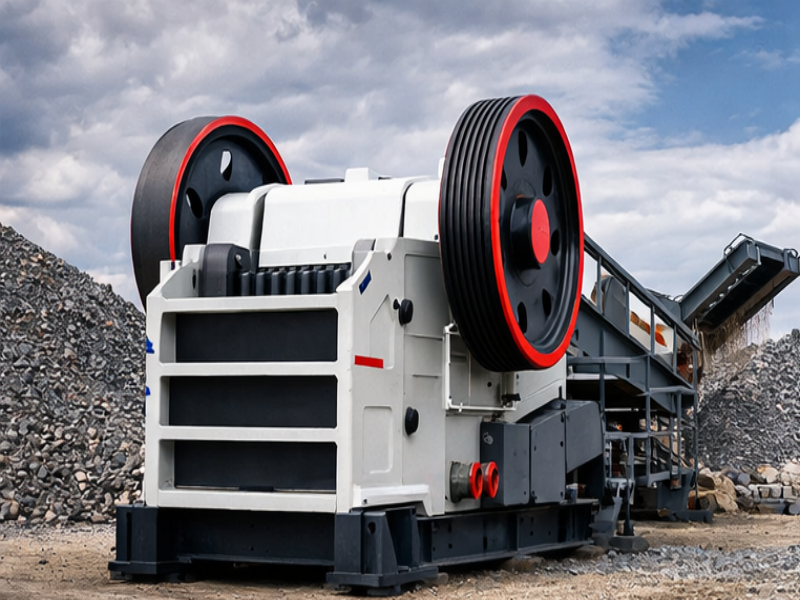
Jaw Crushers are widely used in industries where large, hard, or irregular materials must be reduced to a manageable size at the early stage of processing. Their ability to accept coarse feed and apply strong, consistent compressive force makes them especially suitable for environments where material properties vary and operating conditions are demanding. Instead of focusing on producing finely shaped output, a Jaw Crusher prioritizes reliability, load tolerance, and stable reduction performance, which is why it is often positioned at the front of a processing line.
In mining operations, Jaw Crushers are commonly applied to reduce run-of-mine ore before it moves to subsequent processing stages. Material coming directly from blasting or excavation typically includes oversized, uneven fragments that cannot be handled by downstream equipment. A Jaw Crusher provides controlled primary reduction, helping stabilize feed size and improve overall process efficiency. Its robust mechanical structure supports long operating cycles, making it suitable for both underground installations and surface mining sites where continuous operation is critical.
Quarrying and aggregate production represent another major application area. Jaw Crushers are frequently used to break down natural stone such as granite, basalt, and limestone into sizes suitable for screening or further crushing. Their simple operating principle allows them to maintain consistent throughput even when feed composition or hardness changes. In construction material processing, Jaw Crushers are also used to handle concrete, masonry, and mixed demolition waste, where feed material may include steel reinforcement, variable density, or inconsistent shapes.
Typical application environments include:
● Mining sites handling hard rock and metal-bearing ore, where large feed size and durability are key concerns
● Quarries producing aggregates for roads, buildings, and infrastructure projects
● Construction and demolition material processing facilities managing recycled concrete and masonry
Industry sector | Primary role of a Jaw Crusher |
Mining | Initial size reduction of extracted ore |
Quarrying | Primary crushing of natural stone |
Construction | Processing concrete and masonry materials |
Across all these scenarios, the role of a Jaw Crusher remains consistent. It reduces large, unprocessed material into smaller fractions that are easier to handle, transport, and prepare for later stages. This is achieved without relying on complex mechanisms or high-speed impact forces, making the Jaw Crusher a dependable solution wherever strong primary size reduction is required.
A Jaw Crusher is a primary machine for crushing large materials.
It works by compressing material between fixed and moving jaws.
It is widely used in mining, quarrying, and construction processing.
Shuangfeng Qirun Machinery Parts Imp&Exp Co., Ltd. provides reliable Jaw Crusher solutions, offering durable components and professional support that help improve efficiency and long-term performance.
A: A Jaw Crusher is used for primary size reduction, breaking large hard rock, mined ore, and recycled materials into smaller pieces suitable for further processing.
A: A Jaw Crusher works by compressing material between a fixed jaw and a moving jaw, repeatedly applying force until the material is small enough to discharge.
A: A Jaw Crusher is typically installed at the primary crushing stage in mining, quarrying, and aggregate processing plants.
A: Jaw Crusher output size is mainly controlled by the discharge gap between the jaws, which determines the maximum size of material that can exit.
A: A Jaw Crusher can handle hard rock, blasted ore, limestone, concrete, and mixed construction debris with varying hardness.
A: A Jaw Crusher is specifically designed for primary crushing, where large and irregular feed material must be reduced efficiently.


